 |
|
|
 |

|
 |
|
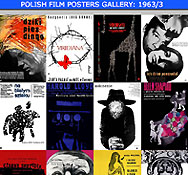
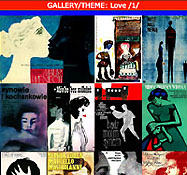
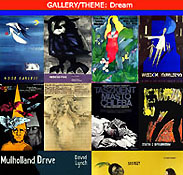
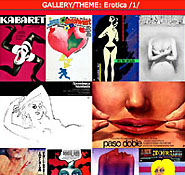
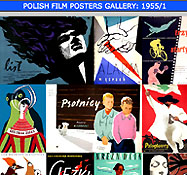
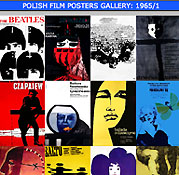
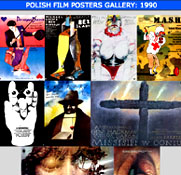
This site covers the work of 426 known designers of 7163 film posters with 4229 uploaded images (so far). It contains a database of Polish film posters and a number of browsable sections, as shown on the navigation bar above and as described below. As much as I'd like to (eventually) provide all available information on all Polish film posters ever printed and every artist who ever designed one, my emphasis is on the best period of the mid 50s to early 70s. Polish film posters practically ceased to exist at the end of the 80s, having been replaced by standard issue foreign ads. All these are absent from the database. The site is about posters rather than films, so my primary concern is to provide the most complete information available on each individual poster : its designer, date, existing versions and variations, circulation, rarity and value. I also tried to identify original films and find basic info for each title. The most valuable information comes from the
poster itself. While there are some variations in actors' or
director's names spelling - especially in the earlier works -
the artist's signature, date and circulation numbers are indisputable.
If there are no such markings (or a poster to read it from),
a variety of sources often made identification possible.
Posters could also be dated by censor codes - a series of numbers printed at the (usually) bottom edge - very reliable method if applied to the Nowogrodzka 64-A (Warsaw) printing house output, but useless with others (Lublin, Gdansk, Kielce). Then there are various albums and show fliers, official artist biographies, etc. etc. Still, authors of 168 posters remain unidentified (listed in database as "Unk"(-nown), and 45 others (pre-war) as "Anonymous". Some more are missing such basic data as the country of film production (7), year (2) and original film title. Another 23 are dated by approximation. Site map :
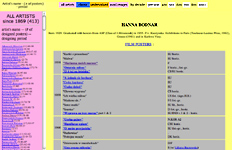
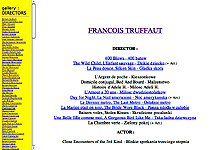
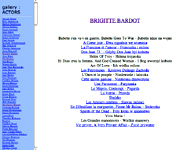
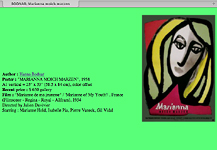 Each name is linked to a corresponding individual poster pages page containing a brief CV and a table of all authored posters, grouped by the year of the poster's design (not the movie release date) & Polish title (with original film title if a well-known classic). The third column lists size, signature info (if any) and the country where the film was produced / film's original language. Titles in bold type are available for sale / trade. 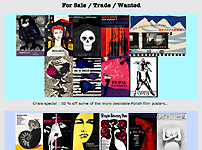
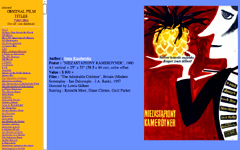
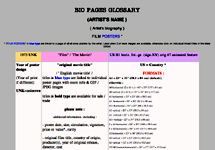
 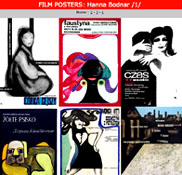 From there, further links lead to biographical page containing a brief CV and a table of all authored posters with pictures and additional information (exact size, circulation, value of poster + original film title, producer, director, actors and the year of original film release). If more than two images by a particular artist are available, the "bio" page has a link to an individual "gallery" of all available images of posters designed by that artist, all linked back to their separate pages.
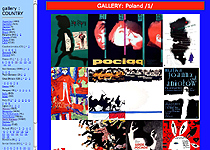
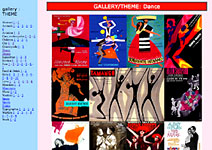
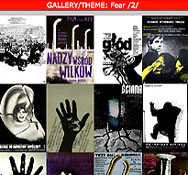
- site search : by keywords. - what's new : updates, new photos, events, etc. - links : list of galleries, databases, collections and other sites dealing with Polish posters.
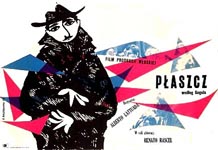
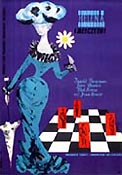
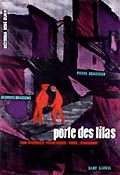
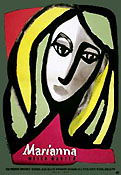
Polish poster design overview : A lot of patronizing drivel had been written about the 'Polish School' of poster design being a 'product' of a 'resistance to Communism' or some such (and by extension, of an overwhelming desire to breathe free under learned guidance of a Drumpfster and First Ladyboy Melanie, Leaders of the Free World). That view, espoused by Western writers who don't know any better, and Polish ones (who should know better) has been more or less omnipresent. No matter that the idea of art as an expression of political circumstance is par excellence a classic communist one. In fact, quite the opposite seemed to happen : free from commercial stranglehold, these artists produced brilliant works over an extended period of time. A lot of talented people found themselves in the right place at the right time. Like any artistic movement (or 'school'), it had its own dynamics, peaks and valleys. Indeed, some of the most accomplished works were political (pro-socialist). And now the fact that Polish film poster is dead (and had been so since shortly after 1989 when "freedom dawned", and more to the point, film distribution was privatized) is further evidence of that. 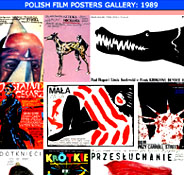
The censorship debate seems irrelevant; aside from some agitprop films, it's hard to argue that the men with scissors had much to concern themselves with. One exception was the 1948 to 1954-55 period, when actual presentation mattered and "modernistic" style was frowned upon; even then however "social-realist" images were few and far between.The results this hands-off policy produced were often brilliant, sometimes dreary and self-indulgent, often mediocre, but seldom boring and - as a rule - deeply personal. The uniqueness of Polish film posters (and to a lesser degree, theatrical ones) lied in the fact that for 3 decades the artists controlled the content and form of an ad. It allowed unprecedented freedom of expression, created new sensibilities and divorced the medium from immediate and often depressing concerns of their Western counterparts : who gets the top billing, what font is approved and which side of Johnnie the Star's face is better than the other. It might have well been the longest period in modern commercial art history that the keepers gave away the key (albeit in a limited and marginal market), with consequences even now. The essence of Polish poster school was a desire to create a graphical synthetic view of an idea expressed by the advertised event. Waldemar Swierzy summed it up so : "Here's how I understand the idea of the poster: ... the theatrical poster has to be a synthesis of two hours, because it can not be told as in the theater, where we have the two hours sitting in comfort in the warmth. The poster is looked at in the passing, in the rain, in winter at the bus stop, in the crowd, so it must be only a signal, suggestive character for the passer-by to register.."
In the mid-70s to mid-80s, the "Polish School" of poster design was suffering from atrophy of fresh ideas. Apart from the works of few artists who basically continued the previous trends, most posters from that period seem uninspired. In the 80s, the designs became politicized, with hardly any new designers entering the field. Some interesting trends emerged, signified by some works of Stasys Eidrigevicius and Wieslaw Walkuski, but overall quality of designs went rapidly downhill.
the way it worked Money not usually being their main consideration*, the artists strove to show off and the pool of talent was large enough to assure artistic quality. Of the 7000 + Polish film posters, at least a quarter could be described as very good, "awesome", 'cool' or whatever the vernacular of the times. Indeed the overall standard (despite some duds from the 70s and 80s) was consistently high.
The established designers who had the first pick of titles were constantly nipped at knees by young upstarts who delighted in the opportunity for their work to be showcased in public places all over the country. The seniors were accomplished enough to command artistic respect though. The process was self-policing and here's how Zuzanna Lipinska - daughter of Eryk, one of the Founding Fathers of the movement - described it : "I worked as poster designer in Poland in the early seventies, mainly designing film and theatre posters. To become a film poster designer as a young art graduate, you had to become a member of the Artist Union, to start with. Then get your name on the list of potential designers and attend the screenings of the films, before they were released. After each screening, you put your name down on the list of people who saw the film, and then Mister Rog, who was responsible for giving commissions, would choose the designer." "The designer would be given a set of films stills. Obviously American, French and Italian films were more popular and the screenings were crowded. If the film was very well known, the commission was given to a well known designer, even without him having to attend the screening. We, young unknown artists, were left with Bulgarian, Romanian and similar films, but every opportunity to design a film poster was thrilling." "We had 2 weeks to do it. Posters were produced in 1:1 scale. In most cases the lettering was done by hand." "So once the poster was done, it was presented in front of the panel of 4-6 well known poster designers and they would either accept it or reject it. Sometimes they would give a "distinction" if the poster was very good - which meant an additional 50% on your fee. A fee for poster design was just below a monthly average salary in Poland, so it was quite good." "Sometimes they would ask for some corrections and changes. Sometimes they would reject it all together. All this was necessary to assure a high level of the design. If it was totally rejected, a new project was presented in a week." "In case of Polish films, the directors often would choose a designer themselves to do the poster, and they had the final word." "Posters were mounted or done directly on a stiff background, so they could be displayed in front of the judging panel. Each designer was given 10 copies of the printed poster. I am talking here about late 60s - early 70s - afterwards things were different." Despite the plurality of styles the posters shared a common characteristic : rather than ads they were a variation on a theme, an interpretation, a commentary. As an ironic reaction of sorts to so many 'arty' designs, there was even a short-lived, tongue-in-cheek trend with posters deliberately stylized to resemble Hollywood playbills. It is hard to speculate whether this form of advertisement was more effective than the garden-variety kind. For one, no pressure existed for the exclusive State distributor to push one film over another. The system worked by word of mouth and the typical blockbusters (Westerns and swashbuckling capers in the 60s, big war movies of the 70s, action thrillers of the 80s) would find their clientele no matter what the poster looked like. Many posters for the likes of "Guns of Navarone" were quite pedestrian; or ironic, as befitting a serious artist in need of a challenge presented by more sophisticated films or, perversely, by unwatchable ones. In fact, the best posters were often for very obscure titles. Of course, "2001", "The Birds", the
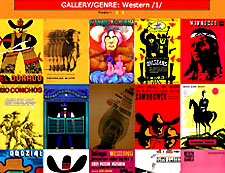
whole Westerns collection, could suggest otherwise,
but in the end it wouldn't matter. Selling or not, it was not
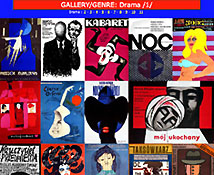
the main concern. It is arguable whether "The Cabaret" would
have a bigger audience if it was advertised with Lisa's 2 legs
instead of four, or if the fact that the film was a huge hit
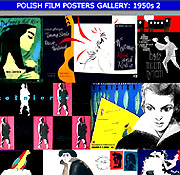
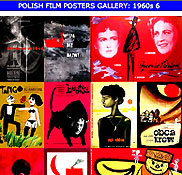
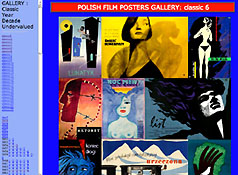
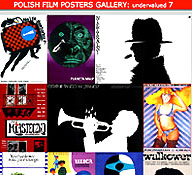
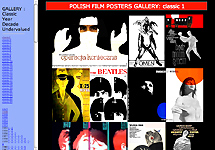
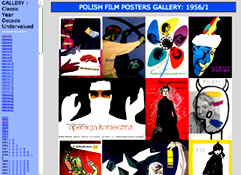
had anything to do with any promotion or lack thereof. 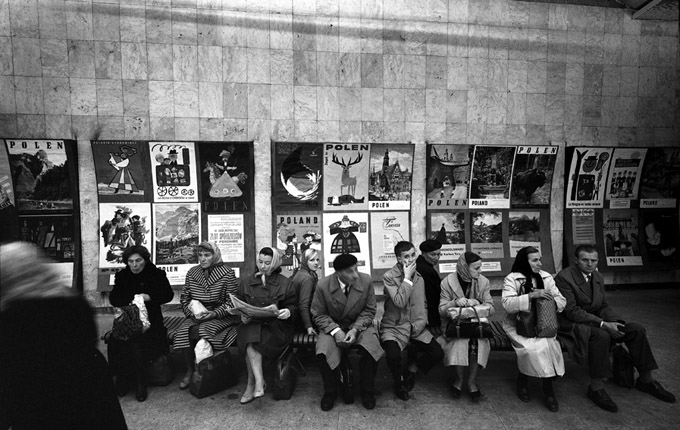 .. nowadays.. For a medium increasingly divorced from street presence, Polish posters enjoy an unexpected following lately and are being rediscovered in strange ways. On this (rather serious) site, there are more hits from art blogs than from anywhere else. One such net article: "50 incredible film posters from Poland" might have done more to popularize the subject than any show in MOMA. Then there's a blog which lets you design your own Polish movie poster, with the added benefit of hilarious machine translation. Another challenges the viewer to "match the Polish poster with the film" and comes complete with priceless comment section. As long as the kids are having fun with them, they live.. The images I included first are of (subjectively) the best posters, even if by more obscure artists. The 50s through the early 70s figure most prominently here. Worth seeing are works by many lesser-known artists, who nevertheless deserve much better recognition. Check out the undervalued link in "gallery" for some wonderful surprises. Which leads me to .. Prices : Price / value info (at individual poster pages) has been compiled from many commercial galleries & auction results for each individual title. Some posters (especially indicated in bold print) are available for sale / exchange by individual enquiry. "Recent price" : most current offering
by any gallery or recorded auction price
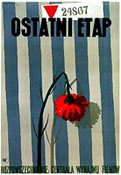
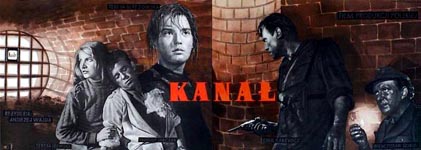
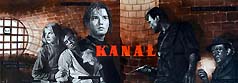
Polish posters didn't fare too well in the West. Due to lack of commercial interest in the early period, these works were virtually unknown outside of Poland. Most were released in small, 3000 to 12000 first runs (4200 - 8000 average), with only a few ever seeing additional printings. The great majority were used for actual advertising and very few found their way to private collections. There was no way of buying these works anyway; they had to be obtained from a friendly theater manager (or a guy who'd put them up on public billboards). As a result, most are extremely hard to find. I personally know of no more than 40 large private collections worldwide, mainly in the US, Poland, Japan, UK, The Netherlands, Germany, Switzerland and France. Paradoxically, the rarity makes them wonderful collectibles : cheap because not well-known, yet with prices nowhere to go but up. There is no surplus of these classical works in Poland or anywhere else in the World. Prices vary from $100 - 250 (inexpensive, mostly 70s and 80s posters), to $250-500 (moderate, 60s and some 50s works of the better-known designers), $500-1000 (expensive, well-known pieces of very well-known designers), $1000-7500+ (the best-known, rare individual titles). In each category there is enormous growth potential. Most Polish film posters remain on the cutting edge of poster design even now, and are not just nostalgia pieces. The best works should reach the $10 K range within a decade, and an average price may easily quadruple. Right now, they are still a bargain : at a 4-8-98 Sotheby's auction, a Swierzy "Midnight Cowboy" poster sold for $690, well below its replacement value of $1800-2200. A Fall 1999 Christie's London auction brought £450 ($900 ) for Anczykowski's "Kanal" poster, listed at $2000 by a New York commercial gallery in 2003. These works are in the "expensive" category. A gallery in England lists Zelek's "Ptaki" ('The Birds") 1963 poster at £1500 ($2900+), and in NY it could be had for $ 3500. Ditto Janiszewski's "Moulin Rouge" 1955 poster ($4500), and Swierzy' "Sunset Boulevard" ($7500+). These are exceptions. The bulk of Polish film posters are sold by commercial galleries in the $150 - 350 range. Check out links for a list of some such establishments. Most of these vendors are not well versed in the subject. On the many dealers' Internet sites spelling mistakes are the rule, posters are misdated and presented "all over the place", without any chronological, thematic or logical order. Many (especially US) collectors seek their favourite movies and/or stars, which explains sometimes wildly diverse prices. As an example, a wonderful 1958 A1 size reissue of 1948 "Ostatni etap" Trepkowski poster lists anywhere from $800 to $2600, depending on the knowledge (or lack thereof) of the gallery appraiser. It should be worth at least $4000 within several years. Collecting tips / things to avoid : 1. Stick to the golden age (mid 50s to late 60s / early 70s) and pick a favourite designer(s) or a theme. Some artists continued their best efforts well into the 70s and beyond, but generally : late 60s seem tired, 70s - flat and uninspired, 80s - repetitive and boring and the 90s nailed the coffin shut. Anything pre 1955 will be worth having, if only for serious trades. 2. Almost all collectible pieces are in the A1 format. Some of the 40s original well-known B1-size classics have been reprinted in A1 in the 50s, and these second runs are actually more valuable. The format switch occurred again at the end of the 70s, and - almost without exception - all the 80s and 90s posters are B1. It'll be years before the (very) few of these will gain real value - now they are just wallpaper. 3. In the 80s, the matte paper on which most earlier posters have been printed was substituted with cheap glossy stock reminiscent of the Western "movie posters". Also, there was a logo switch, from the earlier "CWF" to "Poltel". Stay away ! 4. In addition to the above no-no's, a presence of English, French or German titles (sometimes coupled with the absence of Polish ones) is an indication that the poster was intended as a promo for foreign release, usually in the 80s, always in the B1 format. These posters are generally much less valuable than the Polish originals. A sample list of the most sought- after, classic Polish film posters :
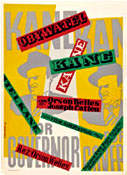
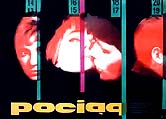
... and bargains : Almost anything by the following artists is very likely to be a bargain : Baranowska, Bochen, Bodnar, Butenko, Cherka, Dabrowski, M. Heidrich, Janczewska, Janiszewski, Jaworowski, Karczewska, Kiwerski, Koscielniak, Krajewski, Mann, Niklewska, Srokowski, Stryjecki, Syska, Szaybo, Wasilewski, Zagorski and Zbikowski. Sizes : Many posters, especially before 1954 and after 1980 were issued in the B1 (26.4" x 38.4" = 67 x 97.5 cm) format, as opposed to the standard A1 (23" x 33" = 58.5 x 84 cm) size. As the latter is easier to manage and most of the best works were issued in A1 anyhow ( even some reissues of the original B1 posters, such as "Citizen Kane" or "Ostatni etap"), they usually command higher prices. During the "Golden Age" of 1955-1965 , virtually all posters were released in the A1 format, with occasional A2 (16" x 23" = 40.5 x 58.5 cm) and B2 (19.2" x 26.4" = 48.8 x 67 cm) versions. There were also some oddball sizes, such as narrow vertical (rarely : horizontal) strife : half of A1 (11" x 33" = 28 x 84 cm) or 1/2 of B1 (13.4" x 38.6" = 34 x 98 cm); B2 square (about 20.5" = 52 cm + variations thereof); and A-0 (double A1 = 117 x 84 cm) consisting of 2 standard size (usually vertical) parts, that - combined - form a horizontal banner-like poster (such as Lenica's "Krzyzacy" or Zamecznik's "Lotna" and "Pociag"). These are very rare and highly collectible.
Circulation : Most posters were issued in small quantities. Some (especially in the early and mid 50s) had larger intended circulation (12000 to 22000), usually greatly reduced at printing time. Standard runs were : 4200 - 6000 - 8000 - 11500, with most in the 4200 - 8000 range. Now, often just a few copies survive. These posters were never intended (or available) for sale, being used all over the country in 1200+ theaters, and stuck on billboards, street fences and advertising kiosks. To obtain a film poster someone involved in their distribution had to help. Collections : As a result, large holdings (1000+ titles) are surprisingly few in Poland (+-10 private, another 10 institutional). In the US, I am aware of about 15, even less in the UK, France, The Netherlands, Germany, Switzerland and Japan, though there are a number of small (200-400 titles) collections. Most commercial galleries have at least a few Polish posters for sale, usually the less desirable 70s to 90s pieces in the $150-300 range. Only a few deal in the truly classic - check links for dealers, galleries, etc. This is an ongoing project. Please email any questions, comments, corrections, suggestions, requests to buy/ sell/ trade, etc. © Tom
Kuznar 1998-2021
|
|
|
|
|
|
Best Custom Writing
|